 Photographic illustration. Atmospheric, not literal.
Sixty-six matches. 319 league goals. One unbeaten champion. One 59-goal attack that still did not go up. A third-tier season that deserves more than a final table screenshot.
Photographic illustration. Atmospheric, not literal.
This is the full season audit of 2. deild kvenna 2025, rebuilt as a league-operator dossier rather than a compact sample. It is written for the people who need to make decisions from the season: committee members, sponsors, club chairs, coaches, media officers, and the clubs entering the 2026 cycle.
The division listed thirteen clubs. Twelve played. KH withdrew before a ball was kicked, so the sporting competition became a twelve-club single round-robin: eleven matches per active club, sixty-six matches in total. Those matches produced 319 goals, or 4.83 per match. The public player register listed 311 players, of whom 291 had at least one appearance. The same register attached 309 goals to named players, leaving 10 goals sitting outside the player rows as own-goal, administrative, or unlisted-scorer residue.
The table tells the first story. Selfoss won eleven from eleven and conceded seven. ÍH scored fifty-nine, ran the best goal difference in the league, and then did not appear in the 2026 third-tier field. Völsungur finished third and moved up. Vestri finished sixth, but produced a thirteen-goal forward who moved to the second tier. Smári finished without a point and returned for another season.
A league report at this price has to do more than repeat those facts. It has to explain what they mean, where the competition is strong, where it is fragile, what a sponsor can sell, what a committee should track, and which clubs are carrying the 2026 story before the first fixture is played.
| Metric | 2025 read |
|---|---|
| Registered clubs | 13 listed; 12 active; KH withdrew before playing |
| Matches played | 66 |
| League goals in standings | 319 |
| Goals per match | 4.83 |
| Player-register goals | 309 (10 not attached to a listed scorer) |
| Listed players | 311 |
| Players with at least one appearance | 291 |
| Total appearances logged | 1902 |
| Yellow / red cards | 125 / 2 |
| Ever-present players | 45 |
Three numbers matter before everything else.
First, 4.83 goals per match is not a normal background condition. This was a high-event league. That makes the defensive teams more interesting, not less, because clean control is harder when the competition is open.
Second, two red cards across the whole active season means the league can sell speed and attacking football without also carrying a discipline problem. The yellow-card count is not negligible, but the red-card load is tiny.
Third, the player register and the standings do not reconcile perfectly at scorer level: 319 team goals, 309 named-player goals. That gap is not a crisis; it is exactly why a league dossier has value. It tells the committee where the public record is good enough for storytelling and where the next version of the competition record needs tighter capture.
Forty-six goals gets the headline, but seven conceded is the signature. The average active club conceded 26.6. Selfoss conceded 7. The title was not only a matter of superior forwards; it was a structural gap in match control.
ÍH scored 59, ten more than Selfoss, and finished with +45 goal difference. A normal table read says runner-up. A league-operator read says: why did a team with promotion-level output not appear in either the upward path or the returning third-tier field? The public competition record does not answer that question, so this report does not guess. It flags the issue because it changes the 2026 competitive picture.
Alyssa Daily's 13-goal Vestri season ending in a second-tier move is commercially useful. It lets the league say something precise: this competition is not just entry-level football; it is a visible development layer. If the league wants a sponsor story, player progression is the cleanest one.
Smári's 1-58 goal line and zero points are stark. But thirty-three listed players means the club was not absent. It had registration volume without match stability. For a league committee, that is a support question: onboarding, fixture load, travel, coaching resource, recruitment timing, and whether the competition can help a bottom club become viable rather than merely listed.
As of 3 May 2026, the 2026 competition record lists fixtures and clubs, but not usable player-register rows for the new season. The useful pre-season split is knowns against unknowns. Known: twelve-club field, first fifteen fixtures listed, four new entrants, two promoted-out clubs, three 2025 clubs not present. Unknown: registered squad strength and player movement for most teams.
| Pos | Club | P | W | D | L | GF | GA | GD | Pts |
|---|---|---|---|---|---|---|---|---|---|
| 1 | Selfoss | 11 | 11 | 0 | 0 | 46 | 7 | +39 | 33 |
| 2 | ÍH | 11 | 9 | 1 | 1 | 59 | 14 | +45 | 28 |
| 3 | Völsungur | 11 | 8 | 0 | 3 | 42 | 19 | +23 | 24 |
| 4 | Fjölnir | 11 | 6 | 2 | 3 | 26 | 19 | +7 | 20 |
| 5 | Álftanes | 11 | 5 | 1 | 5 | 28 | 26 | +2 | 16 |
| 6 | Vestri | 11 | 5 | 1 | 5 | 24 | 28 | -4 | 16 |
| 7 | Dalvík/Reynir | 11 | 4 | 2 | 5 | 25 | 21 | +4 | 14 |
| 8 | Sindri | 11 | 3 | 3 | 5 | 20 | 23 | -3 | 12 |
| 9 | KÞ | 11 | 3 | 2 | 6 | 16 | 34 | -18 | 11 |
| 10 | ÍR | 11 | 2 | 2 | 7 | 16 | 32 | -16 | 8 |
| 11 | Einherji | 11 | 2 | 2 | 7 | 16 | 38 | -22 | 8 |
| 12 | KH | 0 | 0 | 0 | 0 | 0 | 0 | +0 | 0 |
| 13 | Smári | 11 | 0 | 0 | 11 | 1 | 58 | -57 | 0 |
KH withdrew before the season began. Their row is administrative rather than sporting and should not be compared to active teams.
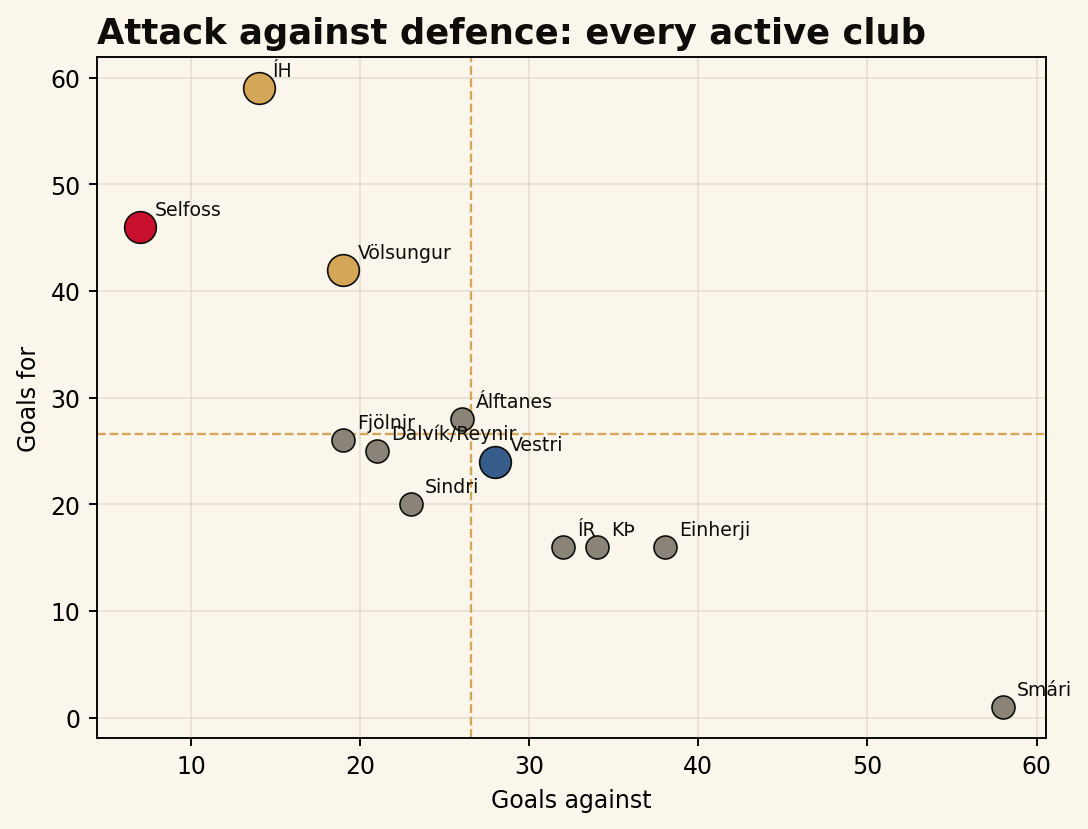
The scatter plot shows the league's real shape. Selfoss are not merely first; they sit in the hard corner, high scoring and low concession. ÍH sit even higher in attack, but with double Selfoss' goals against. Völsungur are the third clear top-end side. Everyone from Fjölnir through Sindri sits in the live middle where two results can change the tone of a season.
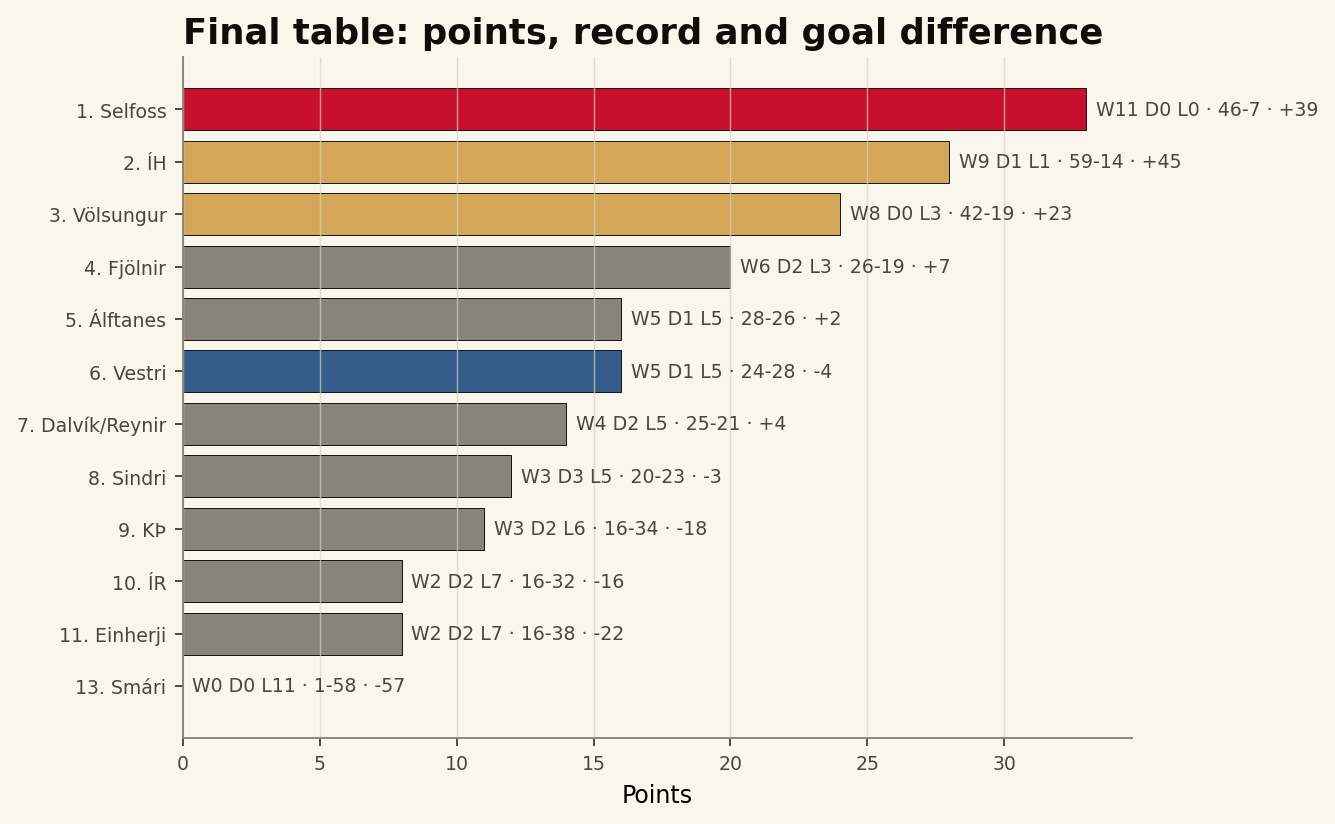
The points strip is the simplest committee slide. Selfoss and ÍH separate. Völsungur form the promotion bridge. Fjölnir are alone in fourth. Then the table becomes a set of cohorts: Álftanes/Vestri, Dalvík/Reynir/Sindri/KÞ, ÍR/Einherji, and Smári.
Selfoss won every match, scored 46, conceded 7, and took the title with a 33-point maximum. The report's key point is that unbeaten seasons are usually explained through forwards because forwards are easier to name. Here, the defensive number should lead. In a league averaging nearly five goals per match, Selfoss conceded 0.64 per match.
Their attack was still serious. Guðmunda Brynja Óladóttir scored 14 in 11, one behind the league leader. Embla Dís Gunnarsdóttir and Lovísa Guðrún Einarsdóttir added five each. But the supporting evidence says this was not a single-player title. Five ever-present players, eight yellows, no reds, and a goal difference of +39 point toward an organised team that spent very little of the season in recovery mode.
The comparison point for 2026 is not whether anyone can repeat 11 from 11. It is whether any returning club can cut goals against below 20. In 2025, only three clubs managed that: Selfoss, ÍH, and Völsungur. Two of those left the division. That leaves Fjölnir as the clearest defensive benchmark among returners.
ÍH are the report's competitive hinge. A 9-1-1 record, 59 goals, +45 goal difference, and four players in the top scorer conversation should usually be enough to define promotion. It did not. The public record shows Selfoss and Völsungur in the higher 2026 tier; it does not show ÍH there.
That creates two reads. The sporting read is simple: ÍH were promotion quality. The competition-design read is more important: the league's pathway is not explained by the final table alone. Eligibility, registration, club structure, or administration can matter as much as finishing position. A public-facing league product should be explicit about that without speculating beyond the record.
For 2026 opponents, ÍH's absence from the third-tier list removes a 59-goal problem. For the league, it also removes a ready-made title contender and changes the marketability of the season. The new story has to come from returning clubs and new entrants instead.
Völsungur finished third, W8 D0 L3, and promoted. The zero draws matter. A drawn match is often a sign of parity, risk management, or lack of end-product. Völsungur played a cleaner binary season: when the match was theirs, it became three points. When it was not, they did not salvage many half-measures.
Halla Bríet Kristjánsdóttir's 13 in 11 is the full-season pillar. Emma Lake Nicholson's 7 in 5 and Krista Eik Harðardóttir's 5 in 3 are the rate stats that make the club feel dangerous beyond the table. Those smaller samples are not enough to forecast a full season alone, but they explain why Völsungur had enough attacking burst to finish above the mid-pack.
The promoted-club question for 2026 is whether the same decisiveness survives when opponents are better. In the third tier, no draws can be a strength. One level up, the ability to turn losing positions into draws often becomes survival currency.
Vestri finished sixth, tied with Álftanes on points, and outperformed the table's first impression. Their story is not only sixth place; it is development. Alyssa Daily scored 13 of Vestri's 24 league goals, then moved to Keflavík for 2026. That is a transfer-market signal the league can use.
It is also a squad-construction problem. Daily accounted for 54 percent of Vestri's team goals. The next listed scorers were Andrea Martinez Monteagudo on 3 and Chloe Hennigan/Lauren Grace Woodcock on 2. A club can replace a five-goal scorer through shared uplift. Replacing a thirteen-goal forward in an eleven-match season requires either a new focal point or a change in how chances are distributed.
The 2026 opener against Smári gives Vestri the most obvious chance in the league to show that the attack has reset. The second fixture, away to ÍR, is the better read. If Vestri take six points before the league's heavier fixtures arrive, they can sell themselves as a top-half returner. If the goals stall, the Daily dependency becomes the season's frame.
Smári scored once, conceded 58, and took no points. That is hard to read and easy to ignore, but competitive balance is part of the league's product quality.
The strange part is squad size. Smári listed 33 players, the highest total in the division, yet no one appeared in all eleven matches and only Minela Crnac scored. That is not just a weak team. It is a team whose registration base did not convert into reliable match output.
The 2026 question is whether Smári can become competitive enough to keep fixtures meaningful. For a sponsor, a league with one club losing heavily every week is harder to package. For a committee, the answer is not public criticism; it is support architecture: earlier registration checks, coaching support, fixture-load monitoring, and practical help for clubs moving from listed squad to stable matchday squad.
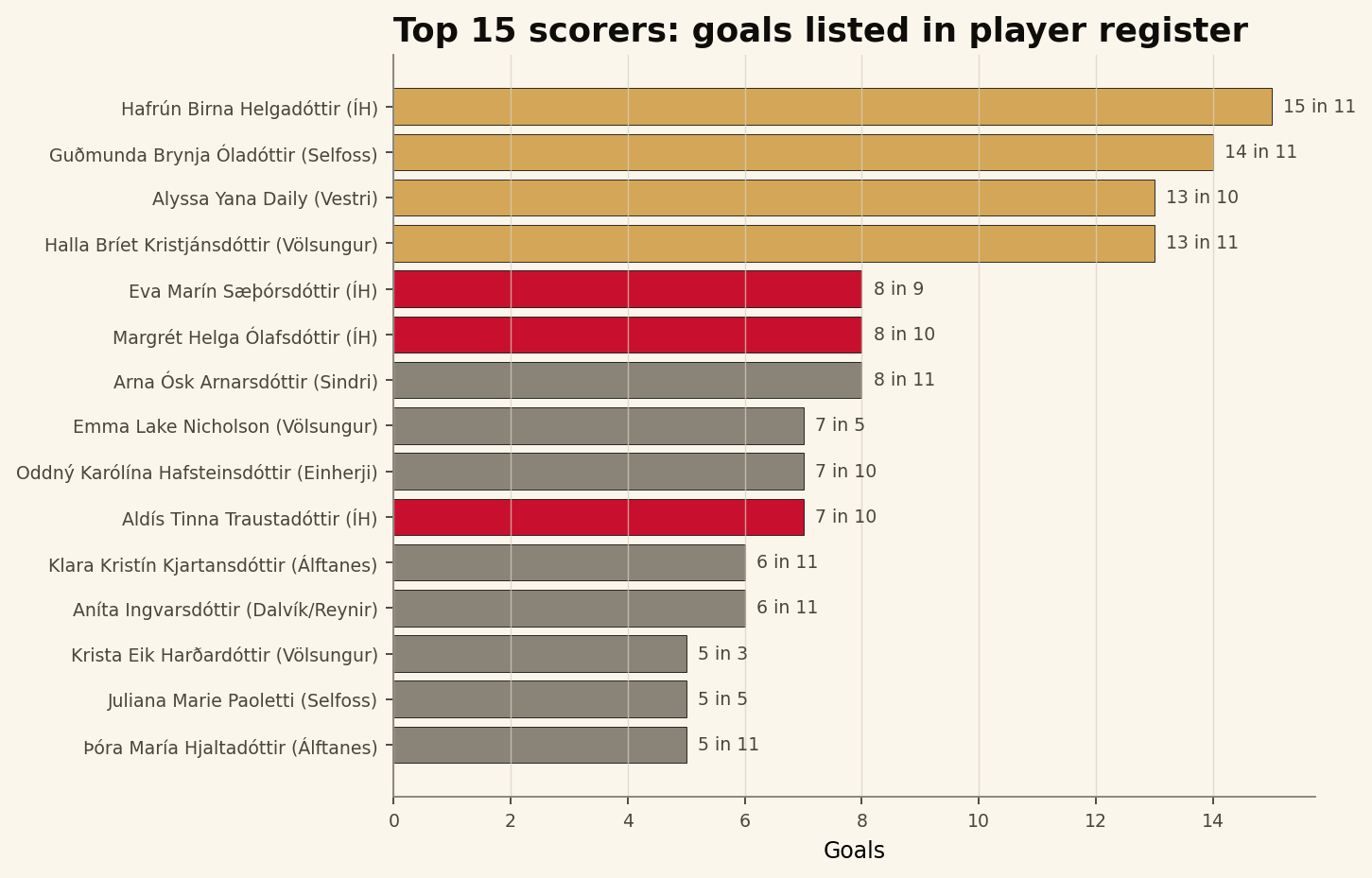
The scoring chart has four headline names: Hafrún Birna Helgadóttir, Guðmunda Brynja Óladóttir, Halla Bríet Kristjánsdóttir, and Alyssa Daily. The important point is spread. The top four come from four different clubs, but the next group tilts heavily toward ÍH. That is why ÍH's 59 goals were not a single-player event.
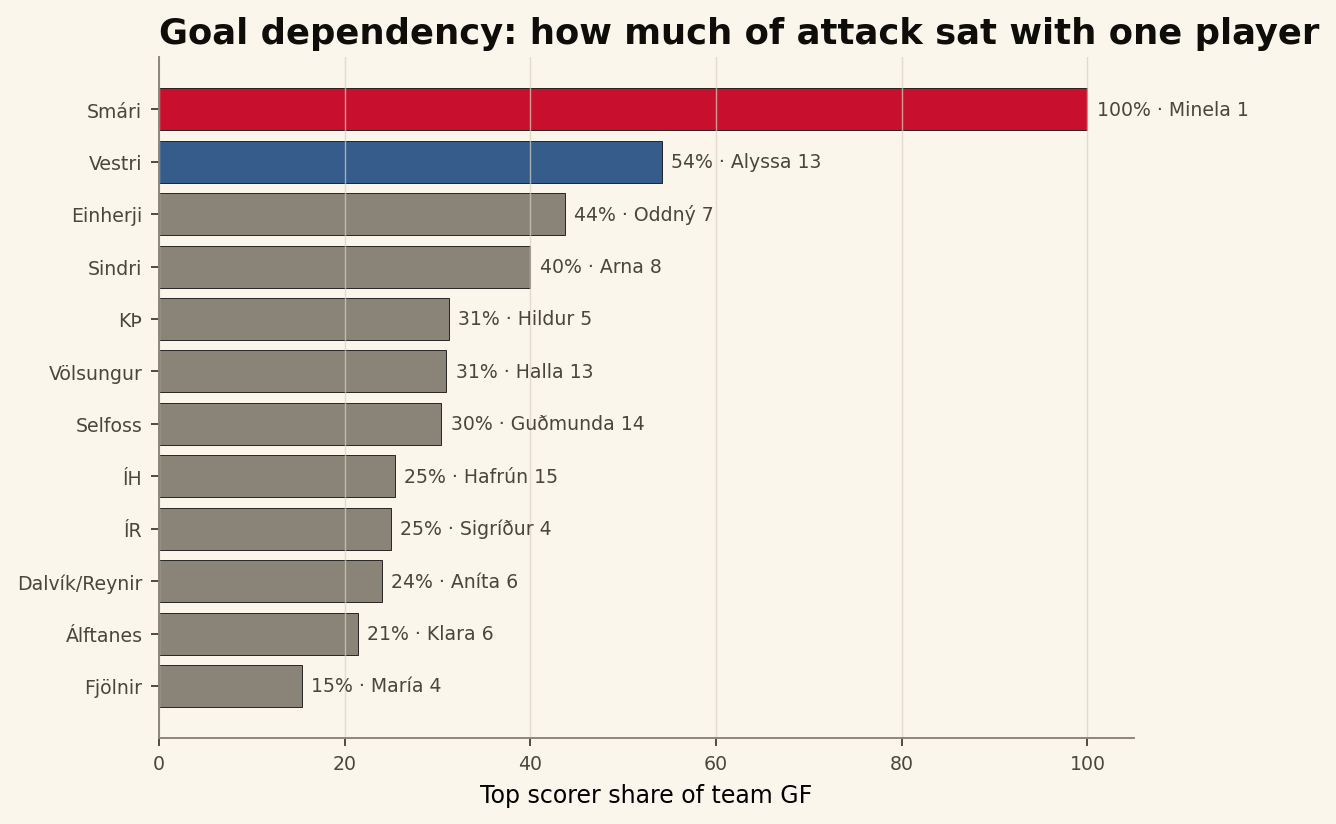
The dependency chart is the Vestri warning light. Daily's share is far higher than the champion profile. Selfoss could lose their leading scorer and still have multiple routes to goal; Vestri could not say that from the 2025 register. This is the kind of chart that makes a report useful to a club chair or coach because it turns a known player loss into a measurable recruitment problem.
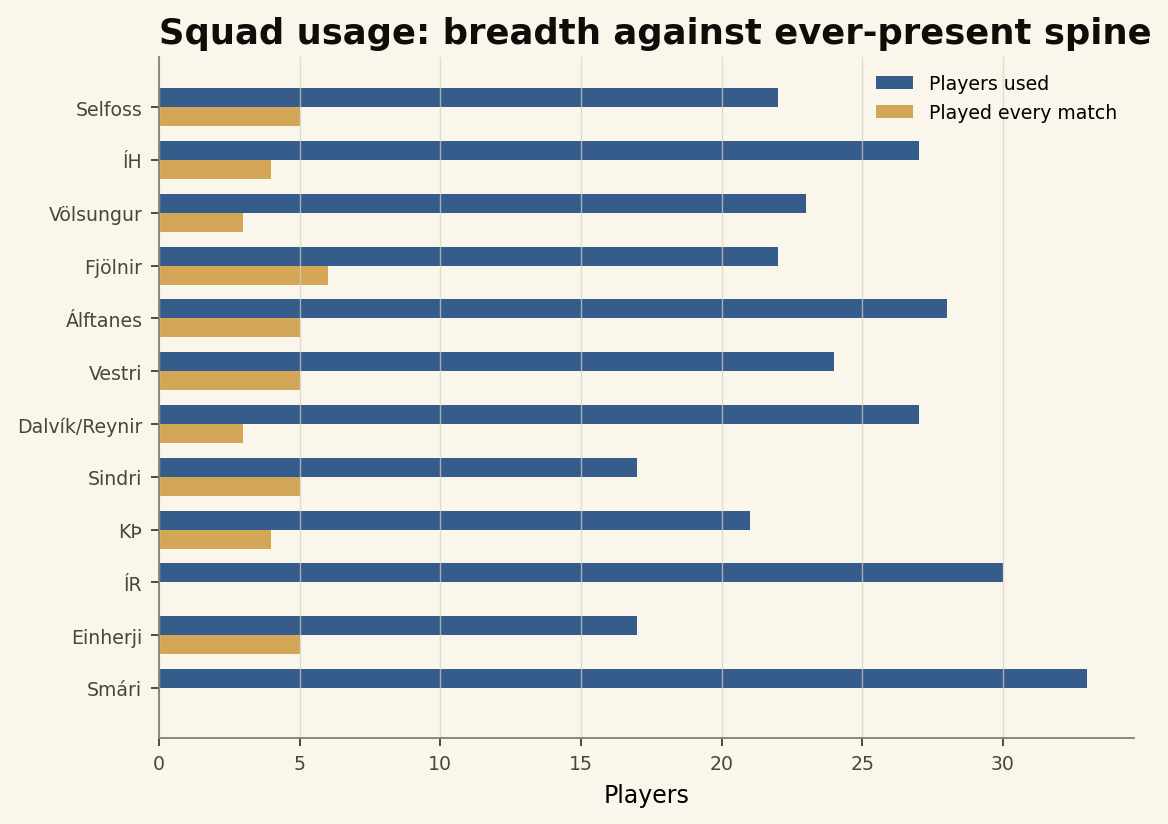
Squad usage tells a different story from squad size. ÍR used 30 players and had no ever-present player. Fjölnir used 22 and had six. Smári listed 33 and had no ever-present player. Those profiles mean different things. Broad rotation can be strength when roles are stable; it is fragility when no spine emerges.
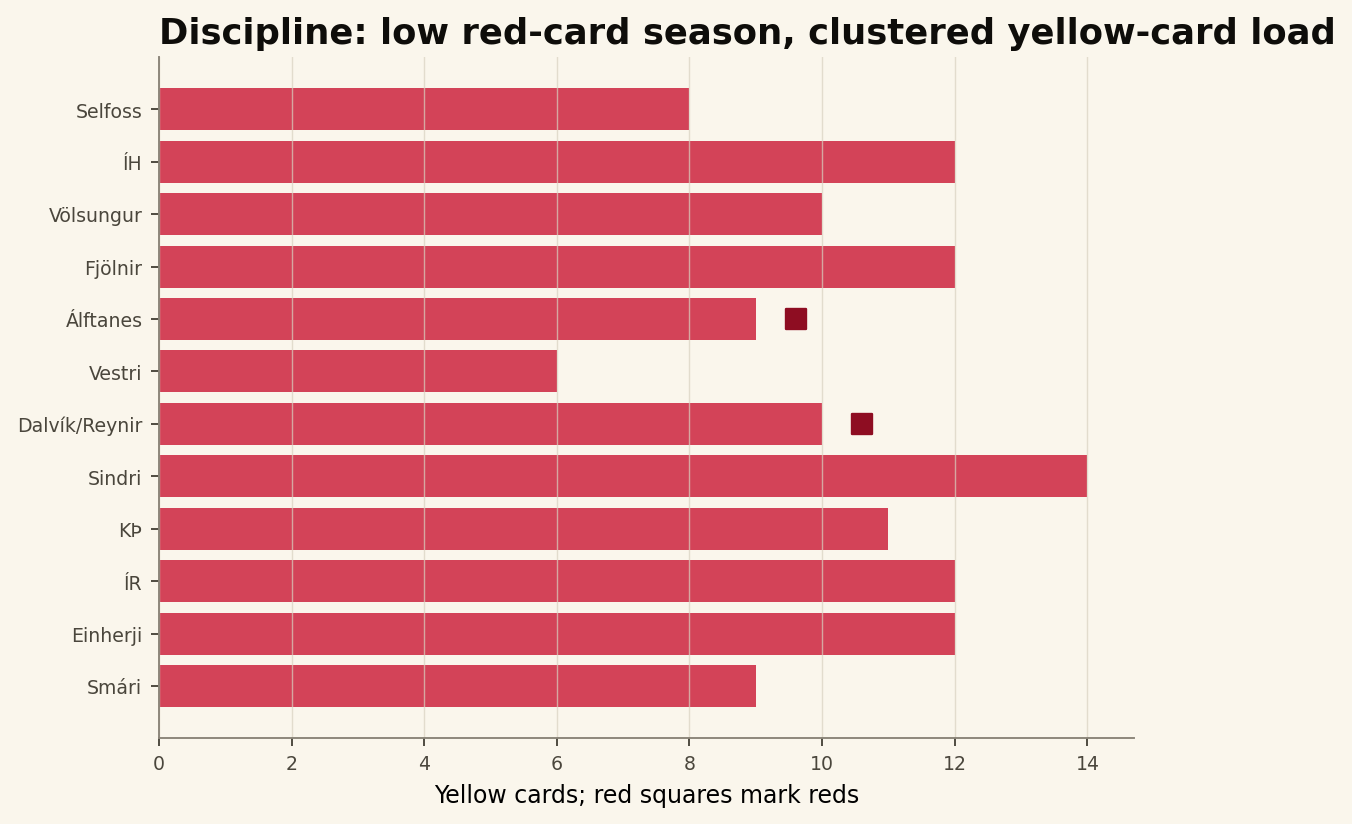
Discipline is not a crisis in this league. There were two red cards in player rows: one for Dalvík/Reynir and one for Álftanes. The more useful committee read is yellow-card clustering. Sindri's 14 yellows sat highest, but even that is not extreme across an eleven-match season. The league's product can honestly be described as high-scoring without being card-heavy.
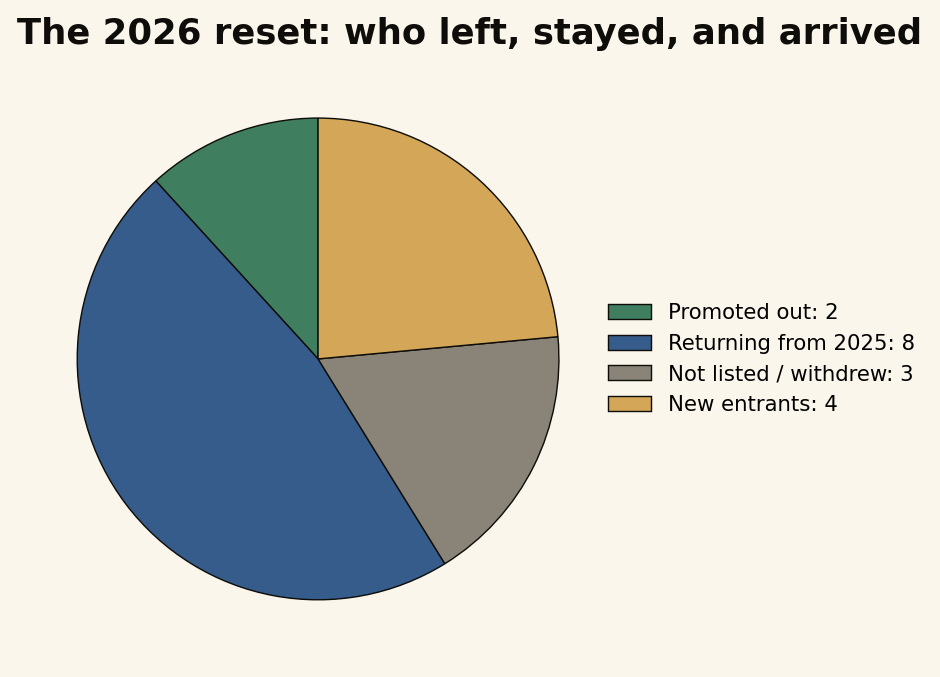
The 2026 field is materially different. Selfoss and Völsungur left upward. ÍH, Sindri, and KH are not listed in the new third-tier field. Eight clubs return. Four entrants arrive: Afturelding, Augnablik, Fylkir, and KFR. That is enough churn to make the new season a reset rather than a repeat.
This is the section that turns the report from an article into a usable league document. Every club gets a comparable read: table line, squad usage, scorer dependency, discipline, and 2026 implication.
| Signal | Read |
|---|---|
| Record | W11 D0 L0, 33 pts, +39 GD |
| Attack / defence | 46 for, 7 against |
| Players listed / used | 24 / 22 |
| Ever-present players | 5 |
| Cards | 8 yellow, 0 red |
| Top scorer share | 30% |
Top scorer: Guðmunda Brynja Óladóttir with 14 in 11 appearances; next line Juliana Marie Paoletti 5, Lovísa Guðrún Einarsdóttir 5, Embla Dís Gunnarsdóttir 5. Discipline: 8 yellows, 0 reds. Availability spine: 5 players appeared in every league match.
Selfoss are the standard-setter because the title was won first without the ball. Forty-six goals is excellent, but seven conceded in an eleven-match division is the number that changed the league. A team can run hot in attack over eleven fixtures; it cannot fake six clean-sheet level control without structure. The player register supports the same read: five ever-present players, goals spread beyond the leading scorer, and only eight yellow cards. That is the profile of a squad that could close matches without chasing them.
2026 use: Benchmark the 2026 champion against Selfoss defensively, not just by points.
| Signal | Read |
|---|---|
| Record | W9 D1 L1, 28 pts, +45 GD |
| Attack / defence | 59 for, 14 against |
| Players listed / used | 28 / 27 |
| Ever-present players | 4 |
| Cards | 12 yellow, 0 red |
| Top scorer share | 25% |
Top scorer: Hafrún Birna Helgadóttir with 15 in 11 appearances; next line Eva Marín Sæþórsdóttir 8, Margrét Helga Ólafsdóttir 8, Aldís Tinna Traustadóttir 7. Discipline: 12 yellows, 0 reds. Availability spine: 4 players appeared in every league match.
ÍH are the essential outlier. They scored fifty-nine, ran a better goal difference than the champions, had the league's top scorer, and still did not appear in the 2026 field tracked here. The public record does not explain the administrative reason. The sporting read is still strong: the second-best team, and arguably the best attacking team, left a competitive gap behind them. That changes every 2026 opponent's planning assumption.
2026 use: Treat ÍH as the missing promotion-level attack that changes the 2026 title picture.
| Signal | Read |
|---|---|
| Record | W8 D0 L3, 24 pts, +23 GD |
| Attack / defence | 42 for, 19 against |
| Players listed / used | 26 / 23 |
| Ever-present players | 3 |
| Cards | 10 yellow, 0 red |
| Top scorer share | 31% |
Top scorer: Halla Bríet Kristjánsdóttir with 13 in 11 appearances; next line Emma Lake Nicholson 7, Krista Eik Harðardóttir 5, Ísabella Anna Kjartansdóttir 3. Discipline: 10 yellows, 0 reds. Availability spine: 3 players appeared in every league match.
Völsungur turned a clean 8-0-3 record into promotion. No draws is the tell: this was not a side living in compromise. When the match moved their way, they converted it into three points; when it did not, they took the loss and moved on. The scoring profile was unusually explosive, with Halla Bríet Kristjánsdóttir ever-present and Emma Lake Nicholson plus Krista Eik Harðardóttir delivering high-rate goals in smaller appearance samples.
2026 use: Track whether the promoted side keeps its no-draw decisiveness one level up.
| Signal | Read |
|---|---|
| Record | W6 D2 L3, 20 pts, +7 GD |
| Attack / defence | 26 for, 19 against |
| Players listed / used | 25 / 22 |
| Ever-present players | 6 |
| Cards | 12 yellow, 0 red |
| Top scorer share | 15% |
Top scorer: María Sól Magnúsdóttir with 4 in 10 appearances; next line Hrafnhildur Árnadóttir 4, Ester Lilja Harðardóttir 4, Kristjana Rut Davíðsdóttir 3. Discipline: 12 yellows, 0 reds. Availability spine: 6 players appeared in every league match.
Fjölnir are the defensive returning contender. Their attack was modest for a top-four side, but twenty-six scored and nineteen conceded was enough for twenty points because the floor was stable. Six ever-present players is the largest spine in the division. That can mean continuity and role clarity; it can also mean thin rotation. For 2026, Fjölnir's question is whether the same spine can add goals without losing the defensive economy that made fourth place possible.
2026 use: A returning contender if a low-goals profile becomes merely average in attack.
| Signal | Read |
|---|---|
| Record | W5 D1 L5, 16 pts, +2 GD |
| Attack / defence | 28 for, 26 against |
| Players listed / used | 29 / 28 |
| Ever-present players | 5 |
| Cards | 9 yellow, 1 red |
| Top scorer share | 21% |
Top scorer: Klara Kristín Kjartansdóttir with 6 in 11 appearances; next line Þóra María Hjaltadóttir 5, Nanna Lilja Guðfinnsdóttir 4, Ásthildur Lilja Atladóttir 4. Discipline: 9 yellows, 1 reds. Availability spine: 5 players appeared in every league match.
Álftanes finished fifth by one goal of goal difference, a small number with a large competitive meaning. The profile is balanced rather than extreme: twenty-eight for, twenty-six against, five wins, five losses, one draw. Their player register skews young at the top of the scoring list, with three 2009-born players among the leading contributors. That makes the 2026 read more interesting than the final position alone: the team may have been a year early rather than a finished mid-table product.
2026 use: Young scoring core makes them more interesting than fifth place looks.
| Signal | Read |
|---|---|
| Record | W5 D1 L5, 16 pts, -4 GD |
| Attack / defence | 24 for, 28 against |
| Players listed / used | 25 / 24 |
| Ever-present players | 5 |
| Cards | 6 yellow, 0 red |
| Top scorer share | 54% |
Top scorer: Alyssa Yana Daily with 13 in 10 appearances; next line Andrea Martinez Monteagudo 3, Coral Fernandez Quinonero 2, Lauren Grace Woodcock 2. Discipline: 6 yellows, 0 reds. Availability spine: 5 players appeared in every league match.
Vestri are the club that makes the 2026 season commercially legible. They moved from the bottom end of the previous cycle to sixth, tied fifth on points, then lost their thirteen-goal forward to a higher tier. That is both a risk and a proof point. The risk is obvious: 54 percent of their league goals came through Alyssa Daily. The proof point is better for the league: a sixth-place third-tier club produced a player the next level wanted.
2026 use: The league's best talent-export story and the biggest replacement-goals test.
| Signal | Read |
|---|---|
| Record | W4 D2 L5, 14 pts, +4 GD |
| Attack / defence | 25 for, 21 against |
| Players listed / used | 30 / 27 |
| Ever-present players | 3 |
| Cards | 10 yellow, 1 red |
| Top scorer share | 24% |
Top scorer: Aníta Ingvarsdóttir with 6 in 11 appearances; next line Hafdís Nína Elmarsdóttir 4, Ragnheiður Sara Steindórsdóttir 3, Arna Kristinsdóttir 3. Discipline: 10 yellows, 1 reds. Availability spine: 3 players appeared in every league match.
Dalvík/Reynir were better than seventh in the underlying balance. A plus-four goal difference from four wins, two draws and five losses says their table position sat inside fine margins, not collapse. The active squad was broad, the top scorer was an ever-present 2009-born player, and the disciplinary line was manageable despite one red. The 2026 opportunity is to turn balanced match profiles into one more win against the clubs around them.
2026 use: Balanced enough to climb if tight games move one result better.
| Signal | Read |
|---|---|
| Record | W3 D3 L5, 12 pts, -3 GD |
| Attack / defence | 20 for, 23 against |
| Players listed / used | 18 / 17 |
| Ever-present players | 5 |
| Cards | 14 yellow, 0 red |
| Top scorer share | 40% |
Top scorer: Arna Ósk Arnarsdóttir with 8 in 11 appearances; next line Sarai Vela Menchon 3, Thelma Björg Gunnarsdóttir 3, Carly Wetzel 2. Discipline: 14 yellows, 0 reds. Availability spine: 5 players appeared in every league match.
Sindri are the absent story in the 2026 reset. They finished eighth with a goal difference only three below even, had a clear leading scorer in Arna Ósk Arnarsdóttir, and did not reappear in the 2026 division list. That matters because the league does not only change through promotion and relegation. It changes through registration, travel, squad continuity, and whether a club can make another season operationally viable.
2026 use: Operational absence changes the 2026 field more than the table suggests.
| Signal | Read |
|---|---|
| Record | W3 D2 L6, 11 pts, -18 GD |
| Attack / defence | 16 for, 34 against |
| Players listed / used | 22 / 21 |
| Ever-present players | 4 |
| Cards | 11 yellow, 0 red |
| Top scorer share | 31% |
Top scorer: Hildur Laila Hákonardóttir with 5 in 11 appearances; next line Þórdís Nanna Ágústsdóttir 3, Hekla Dögg Ingvarsdóttir 3, Steinunn Lára Ingvarsdóttir 2. Discipline: 11 yellows, 0 reds. Availability spine: 4 players appeared in every league match.
KÞ finished ninth with a heavy defensive number. Sixteen goals scored is the same as ÍR and Einherji below them; the difference was that KÞ found three wins instead of two. The goal-against total, thirty-four, is the pressure point. For 2026, they need a cleaner first month because the opening fixtures put them immediately against an incoming club and then Dalvík/Reynir, a team that already showed better balance in 2025.
2026 use: Must reduce the defensive load before the table splits.
| Signal | Read |
|---|---|
| Record | W2 D2 L7, 8 pts, -16 GD |
| Attack / defence | 16 for, 32 against |
| Players listed / used | 31 / 30 |
| Ever-present players | 0 |
| Cards | 12 yellow, 0 red |
| Top scorer share | 25% |
Top scorer: Sigríður Dröfn Auðunsdóttir with 4 in 8 appearances; next line Ólöf Sara Sigurðardóttir 3, Ana Catarina Da Costa Bral 2, Helga Kristinsdóttir 2. Discipline: 12 yellows, 0 reds. Availability spine: 0 players appeared in every league match.
ÍR survived the bottom cluster on goal difference and rotation rather than an obvious scoring edge. Thirty players used and no ever-present player is the most fragmented availability profile in the league. That may reflect genuine squad breadth, but it also means no public-record spine to build the story around. The 2026 opener against Augnablik is therefore more than a first fixture; it is the first evidence of whether the side has a settled core.
2026 use: Needs a visible spine after a fragmented availability year.
| Signal | Read |
|---|---|
| Record | W2 D2 L7, 8 pts, -22 GD |
| Attack / defence | 16 for, 38 against |
| Players listed / used | 20 / 17 |
| Ever-present players | 5 |
| Cards | 12 yellow, 0 red |
| Top scorer share | 44% |
Top scorer: Oddný Karólína Hafsteinsdóttir with 7 in 10 appearances; next line Coni Adelina Ion 3, Bernadett Viktoria Szeles 2, Ainhoa Olivera Fernandez 2. Discipline: 12 yellows, 0 reds. Availability spine: 5 players appeared in every league match.
Einherji finished level with ÍR on points but six goals worse on difference. The squad was smaller than most, yet five players appeared in every match. That contrast is important: the team had continuity, but not enough event production around it. Oddný Karólína Hafsteinsdóttir supplied seven of the sixteen goals. If Einherji's 2026 version adds a second scoring route, the same spine can carry a better table position.
2026 use: Continuity is there; a second scorer is the missing condition.
| Signal | Read |
|---|---|
| Record | Withdrew; no matches played |
| Attack / defence | 0 for, 0 against |
| Players listed / used | 0 / 0 |
| Ever-present players | 0 |
| Cards | 0 yellow, 0 red |
| Top scorer share | n/a |
No multi-goal scorer listed in the public player register. Discipline: 0 yellows, 0 reds. Availability spine: 0 players appeared in every league match.
KH are an administrative line rather than a sporting season. They were listed, played no matches, scored none, conceded none, and did not form part of the active round-robin. Reports like this should not drag a withdrawn club into performance comparison. The correct read is operational: a 13-club listed competition became a 12-club played competition before the season could tell its story.
2026 use: Withdrawal should be treated as competition-design information, not performance data.
| Signal | Read |
|---|---|
| Record | W0 D0 L11, 0 pts, -57 GD |
| Attack / defence | 1 for, 58 against |
| Players listed / used | 33 / 33 |
| Ever-present players | 0 |
| Cards | 9 yellow, 0 red |
| Top scorer share | 100% |
Top scorer: Minela Crnac with 1 in 7 appearances. Discipline: 9 yellows, 0 reds. Availability spine: 0 players appeared in every league match.
Smári's line is severe: zero points, one goal scored, fifty-eight conceded. The club still matters to the league report because bottom-end health is part of competition health. Thirty-three players were listed, the largest squad total in the division, but no player appeared in all eleven matches and only one goal was credited to the squad. The 2026 question is not minor improvement; it is whether the club can turn registration volume into a stable team shape.
2026 use: The bottom-end rebuild is a league-health issue, not just a club issue.
Hafrún Birna Helgadóttir scored 15 in 11 for ÍH. She was not merely the league's leading scorer; she was the leading scorer on the most prolific attack. The age signal matters too: listed birth year 2009. A 2009-born player leading an adult third-tier scoring table is the kind of fact a league should surface carefully and proudly.
The top-scorer race was close enough to be credible. Guðmunda Brynja Óladóttir scored 14 for the champions. Halla Bríet Kristjánsdóttir and Alyssa Daily scored 13. That means the individual award did not come from a weak field; it came from a top cluster where one goal separated first and second, and two goals separated first from third.
Rate stats can mislead in short seasons, but they are still useful as flags. Krista Eik Harðardóttir scored 5 in 3. Emma Lake Nicholson scored 7 in 5. Juliana Marie Paoletti scored 5 in 5. Those are not full-season volume claims; they are efficiency markers. In a recruitment or preview report, those names would go into the follow-up file because limited minutes with high output often reveal either returning fitness, late-season arrival, or role-specialist usage.
Forty-five players appeared in every one of their club's eleven matches. That is a useful availability base for a league of this level. The club distribution matters more than the total: Fjölnir had six; Selfoss, Álftanes, Sindri, Einherji, and Vestri had five; ÍR and Smári had none.
For a coach, ever-present players are trust. For a committee, they are a media product. A league that can name its ever-present players, top scorers, clean-discipline teams, and development moves has a better end-of-season awards structure than one relying on meeting-room memory.
The easiest sell is goals. A 319-goal, 66-match season gives the league a clear content line: supporters and sponsors are not being sold attritional football. The danger is over-selling the goal number without explaining balance. High scoring can mean attacking quality; it can also mean defensive unevenness. In 2025, both were true.
Selfoss and ÍH showed top-end quality. Smári's line showed imbalance. The middle showed volatility. The league should use the number, but pair it with story: unbeaten champion, unresolved runner-up, development exports, and four-club 2026 reset.
The public competition record is sufficient for standings, squad appearances, goals, and discipline. It is not sufficient for deeper tactical work: no reliable event timelines, no shot locations, no substitutions, no minute-by-minute card context, and no complete public 2025 fixture event feed. That means the correct product boundary is important.
A league dossier earns its value when the season aggregates become practical decisions. It can rank attacks, identify scorer dependency, profile club stability, and build 2026 watchlists. Pressing schemes and chance quality need match video or event data, so those claims stay outside this read.
A sponsor does not need every raw file. A sponsor needs a narrative they can stand behind. In this league, the cleanest sponsor lines are:
That is enough to support a season preview, a mid-season newsletter, and an end-of-season awards package. The missing commercial layer is not data; it is packaging.
The next version should track four things better from week one: squad registration changes, scorer attribution gaps, matchday participation stability, and promotion eligibility context. The buyer-facing read can stay clean while the working record behind it becomes more complete.
A league dossier should also make the end-of-season awards easier. The point is not to replace committee judgement; it is to give that judgement a documented shortlist so the conversation starts from evidence.
The public record does not provide positions, so a true XI would overclaim. The safer award lens is the player spine that any discussion has to include:
| Award lane | Evidence-led shortlist |
|---|---|
| Golden boot | Hafrún Birna Helgadóttir, 15 in 11 for ÍH |
| Champion scorer | Guðmunda Brynja Óladóttir, 14 in 11 for Selfoss |
| Promotion scorer | Halla Bríet Kristjánsdóttir, 13 in 11 for Völsungur |
| Development export | Alyssa Daily, 13 in 10 for Vestri before a higher-tier move |
| High-rate impact | Krista Eik Harðardóttir, 5 in 3 for Völsungur; Emma Lake Nicholson, 7 in 5 |
| Availability spine | The 45 players who appeared in all eleven matches |
| Defensive benchmark | Selfoss as a team: seven conceded in an eleven-match title season |
That list is already more useful than a generic awards meeting. It tells the league which claims are safe to publish, which need committee context, and which should be held for a deeper player feature. The key is to avoid over-claiming. A player with five goals in three appearances is not automatically player of the season. She is a high-rate impact story worth a follow-up.
The 2009-born scorers matter. Hafrún Birna Helgadóttir led the league. Klara Kristín Kjartansdóttir scored six for Álftanes. Þóra María Hjaltadóttir scored five for Álftanes. Aníta Ingvarsdóttir scored six for Dalvík/Reynir. In a third-tier league, young players doing adult scoring volume are a development story and a sponsor story.
The careful phrasing is important. This is not a claim about professional projection or senior international potential. It is a claim about current competition value: the league is giving young players meaningful adult minutes, and some of them are producing immediately.
The awards structure should not only reward first place. A league trying to grow its product needs recognitions that reinforce the behaviours it wants. For this season, the shortlist could be:
Those categories create more usable media than a single champion post. They give each part of the table a role in the season's public memory.
The 2026 season starts quickly enough that the league should not wait for the table to settle. A useful public calendar would be:
| Window | Public content |
|---|---|
| Week before kick-off | 2025 audit highlights: goals, champion, top scorer, returning clubs |
| Opening round | Vestri replacement-goals watch; Smári rebuild; new entrants' first look |
| After matchday two | Returning clubs v new entrants: early split |
| Mid-season | Top scorer race, clean-discipline table, squad-stability tracker |
| Final month | Promotion-eligible picture, goal-difference pressure, player movement watch |
| Post-season | Updated league dossier, awards shortlist, sponsor recap |
That calendar is small enough for a volunteer media officer and strong enough for a sponsor deck. It also creates a reason to buy a weekly newsletter during the active season: the newsletter becomes the running layer between annual dossiers.
This section is the difference between an archive and a tool. A committee can read the report and leave with specific actions for the next season.
The standings show 319 goals. The player rows account for 309. A ten-goal gap across a season is not fatal, but it is avoidable. The league should maintain a reconciliation tracker that flags every fixture where team goals and named-player goals do not match, so end-of-season awards and media posts do not become manual detective work.
ÍH's 2025 season proves that table position alone did not explain upward movement. The league should prepare an eligibility note before the final month: who can go up, who cannot, what conditions apply, and how the announcement should be phrased. That avoids the awkwardness of supporters reading the final table and not understanding why the sporting runner-up is absent from the expected pathway.
Smári's 2025 line should trigger support before the 2026 season becomes unrecoverable. That support can be practical: registration timing, coaching resource, fixture-management check-ins, squad-availability monitoring, and early warning if heavy defeats continue. The objective is not to protect the table from bad results; it is to protect the competition from predictable collapse.
Ever-present players are one of the easiest positive stories in a data-light league. They show commitment, reliability, and identity. A monthly "ever-present watch" is simple, human, and sponsor-friendly. It also gives defenders, midfielders, and lower-scoring players a way into the public record.
The published story should stay clean: goals, clubs, players, fixtures, awards, and the run-in. The working record can be more detailed, but the reader should see the finished season argument rather than the production notes.
The annual product should not be a one-off PDF dropped after the season. It should be a cycle:
That is how the annual report becomes the anchor of the product ladder rather than an isolated purchase. The league dossier preserves the season memory; the weekly newsletter keeps people returning while matches are live.
The 2026 third-tier list is not a continuation of the final 2025 table. It is a new field.
| 2025 status | Clubs |
|---|---|
| Promoted out | Selfoss, Völsungur |
| Returning from 2025 | Dalvík/Reynir, Einherji, Fjölnir, KÞ, Smári, Vestri, Álftanes, ÍR |
| Not listed / withdrew | KH, Sindri, ÍH |
| New entrants for 2026 | Afturelding, Augnablik, Fylkir, KFR |
The important sporting consequence is that the two clearest promotion-level attacks are gone or absent from the field in different ways. Selfoss went up. ÍH are not in the 2026 third-tier list. Völsungur went up. That leaves Fjölnir, Álftanes, Vestri, Dalvík/Reynir, and the incoming clubs to define the new top end.
The first public fixtures listed for 2026 are:
| Date | Kickoff | Fixture | Venue |
|---|---|---|---|
| 2026-05-07 | 19:15 | Augnablik v ÍR | Fífan |
| 2026-05-07 | 19:15 | KÞ v Afturelding | Þróttheimar |
| 2026-05-09 | 14:00 | Einherji v Álftanes | Vopnafjarðarvöllur |
| 2026-05-09 | 16:00 | Dalvík/Reynir v Fylkir | Dalvíkurvöllur |
| 2026-05-10 | 14:00 | Vestri v Smári | Kerecisvöllurinn |
| 2026-05-11 | 19:15 | KFR v Fjölnir | SS-völlurinn |
| 2026-05-14 | 14:00 | Afturelding v Álftanes | Malbikstöðin að Varmá |
| 2026-05-15 | 19:45 | Fjölnir v Augnablik | Egilshöll |
| 2026-05-16 | 12:00 | Smári v Einherji | Fjölnisvöllur - Gervigras |
| 2026-05-16 | 14:00 | Fylkir v KFR | tekk VÖLLURINN |
| 2026-05-16 | 16:00 | Dalvík/Reynir v KÞ | Dalvíkurvöllur |
| 2026-05-17 | 14:00 | ÍR v Vestri | Þarfaþingsvöllurinn |
| 2026-05-22 | 14:00 | Augnablik v Fylkir | Fífan |
| 2026-05-22 | 19:15 | Álftanes v Smári | HTH völlurinn |
| 2026-05-23 | 14:00 | KFR v KÞ | SS-völlurinn |
Two fixtures carry immediate story value. Vestri v Smári on 10 May 2026 tests both Vestri's post-Daily attack and Smári's rebuild. Fjölnir v Augnablik on 15 May 2026 tests the best returning defensive spine against an incoming club. Afturelding v Álftanes on 14 May 2026 gives the fifth-place returner an early away benchmark against a new entrant.
As of 3 May 2026, the public 2026 club pages did not expose usable squad rows. That should be stated in the report because it keeps the preview honest. Once those rows appear, the first update should be a player-movement and registration newsletter rather than another table recap.
This sample now sets the product standard more clearly.
A paid league dossier should include:
The value is not a table summary. The value is the structured memory: the same framework applied across clubs, seasons, and leagues, with data gaps named instead of hidden. The report becomes part archive, part commercial pack, part committee briefing, and part scouting brief for the next season.
With Selfoss and Völsungur gone and ÍH absent from the new list, the top of the league is open. Fjölnir are the safest returning-data candidate because they already had the defensive base. Álftanes and Vestri sit close behind because they were tied on points and have plausible upside. Dalvík/Reynir are the quiet value pick because their goal difference was better than their table position.
The new entrants cannot be ranked from the 2025 third-tier data. They should be treated as unknown until squad lists and first results appear.
Alyssa Daily is the named example, but the wider watch is whether more third-tier scorers move upward. Hafrún Birna Helgadóttir, Halla Bríet Kristjánsdóttir, Guðmunda Brynja Óladóttir, and the high-rate Völsungur/Selfoss scorers are all names a next-tier recruitment lens would notice. The evidence supports a watchlist, not transfer claims.
Vestri need to replace 13 goals. Smári need to replace almost an entire attacking system. Fjölnir need to add goals without breaking shape. Álftanes need to turn young scoring contribution into more consistent results. Those are the four attacking questions that matter more than generic pre-season predictions.
The league cannot only celebrate the champion. It needs the bottom to be viable enough that fixtures stay meaningful. Smári's return makes their first month important. If their concession rate falls quickly, the competition improves. If it does not, the league has an operational support issue to solve.
This report uses recorded competition facts available on 3 May 2026, checked against the standings, squad rows, appearance totals, goals, and discipline fields. The buyer-facing value is the season argument, the decisions it supports, and the gaps it makes visible.
Confidence is high for final standings, goals for/against, points, listed squad rows, player appearances, named-player goals, yellow cards, and red cards. Confidence is limited for per-match event detail, scorer attribution for the 10 goals not attached to player rows, 2026 squad composition before registrations are publicly populated, and the administrative reason certain clubs are absent from the 2026 field.
Where the public record is silent, the report says so. That is not a weakness. It is what lets the document be used in a committee room without becoming a speculation sheet.
The complete data, analysis, and recommendations.